
Building and Rebuilding: The History of Lexington Schools
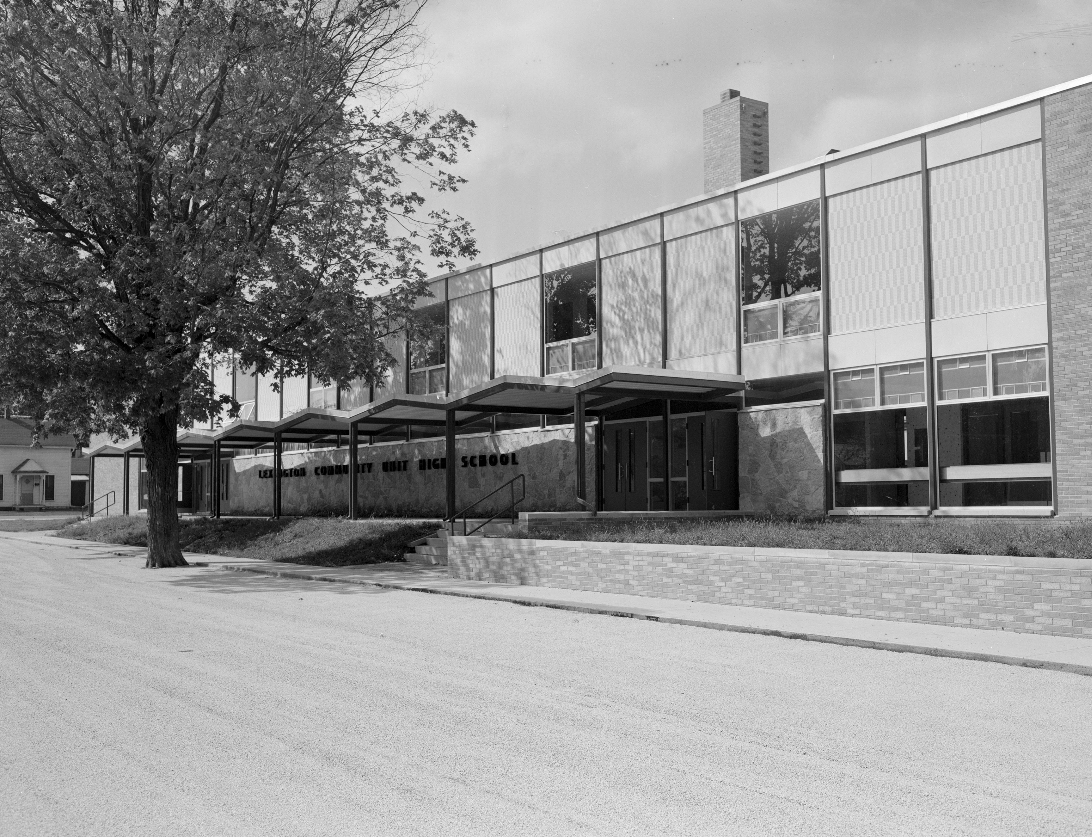
Lexington Community High School, Circa 1961, Source: Elizabeth MacPhail
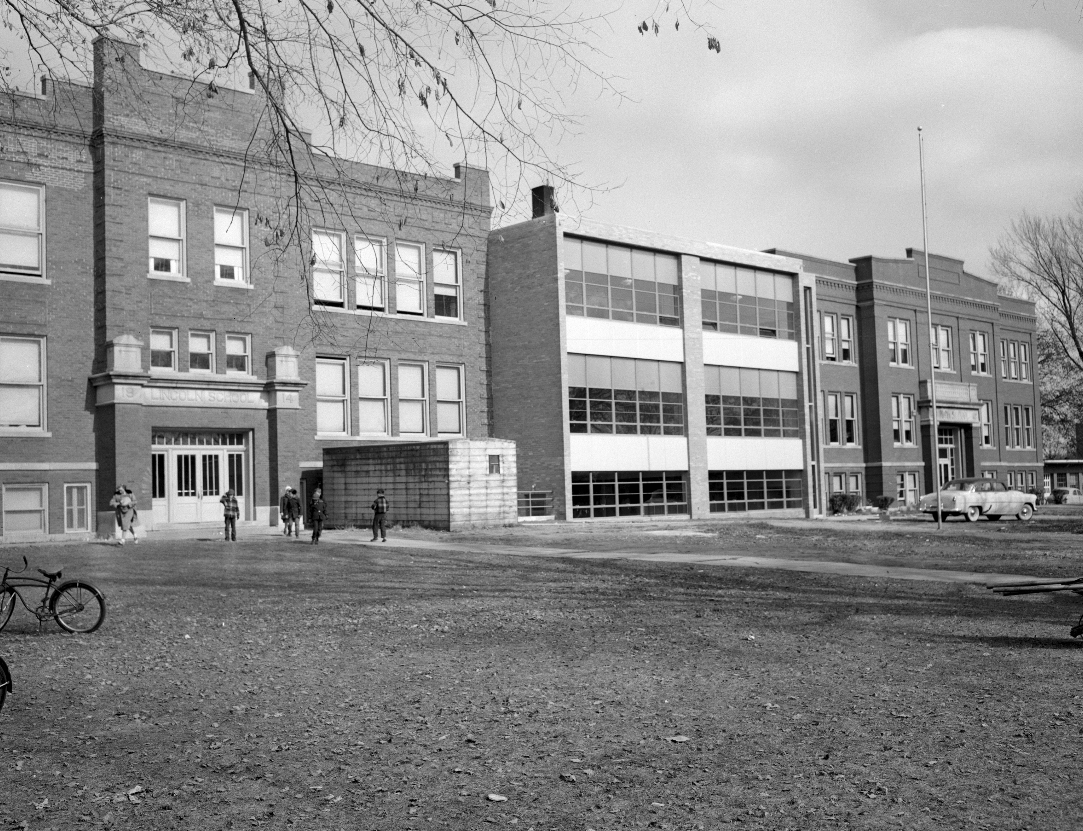
Lexington High School, Circa: Mid 1900s, Source: Elizabeth MacPhail
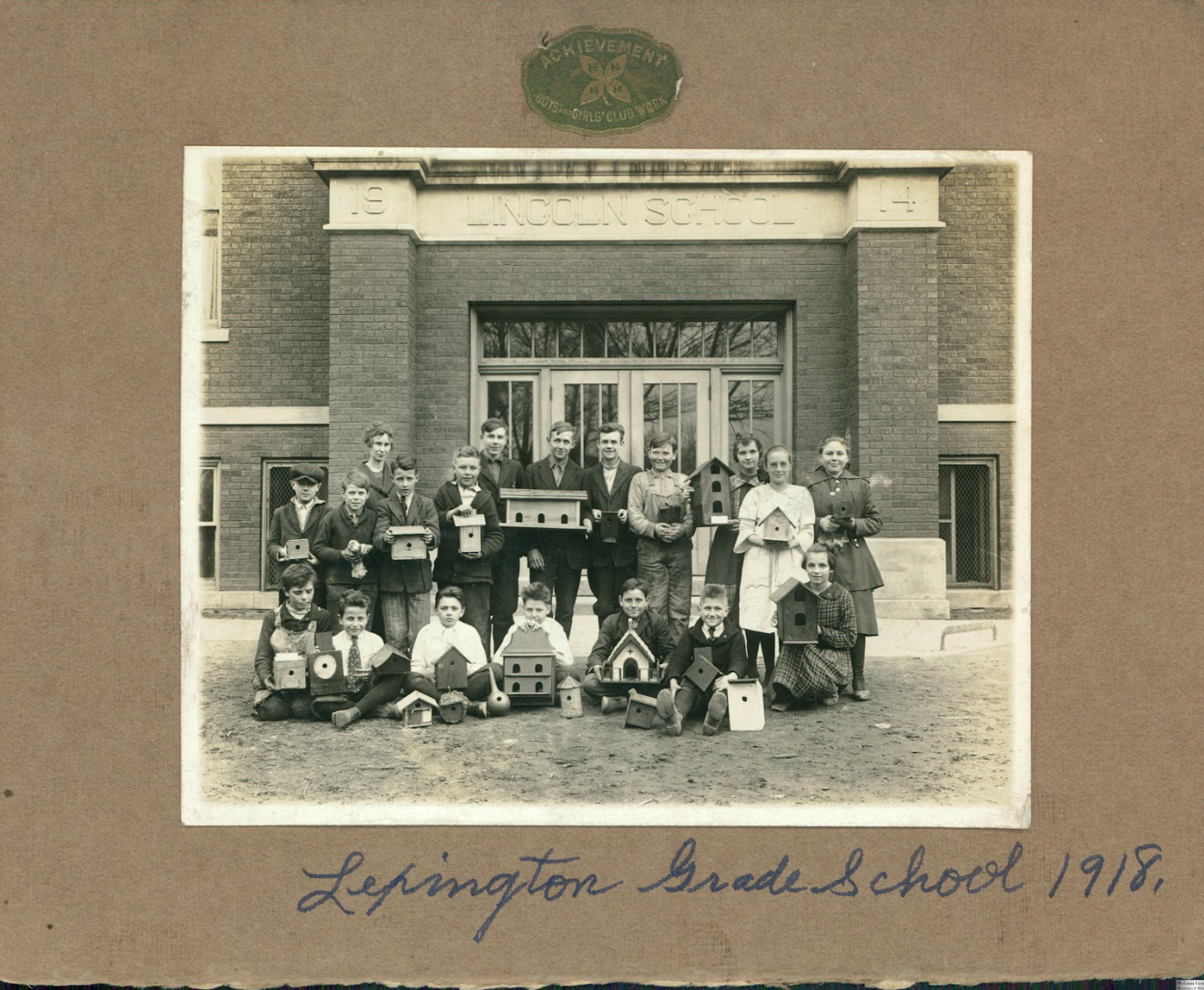
Lexington Grade School, Lexington IL, Children with Birdhouse projects 1918, William Brigham Photograph Collection
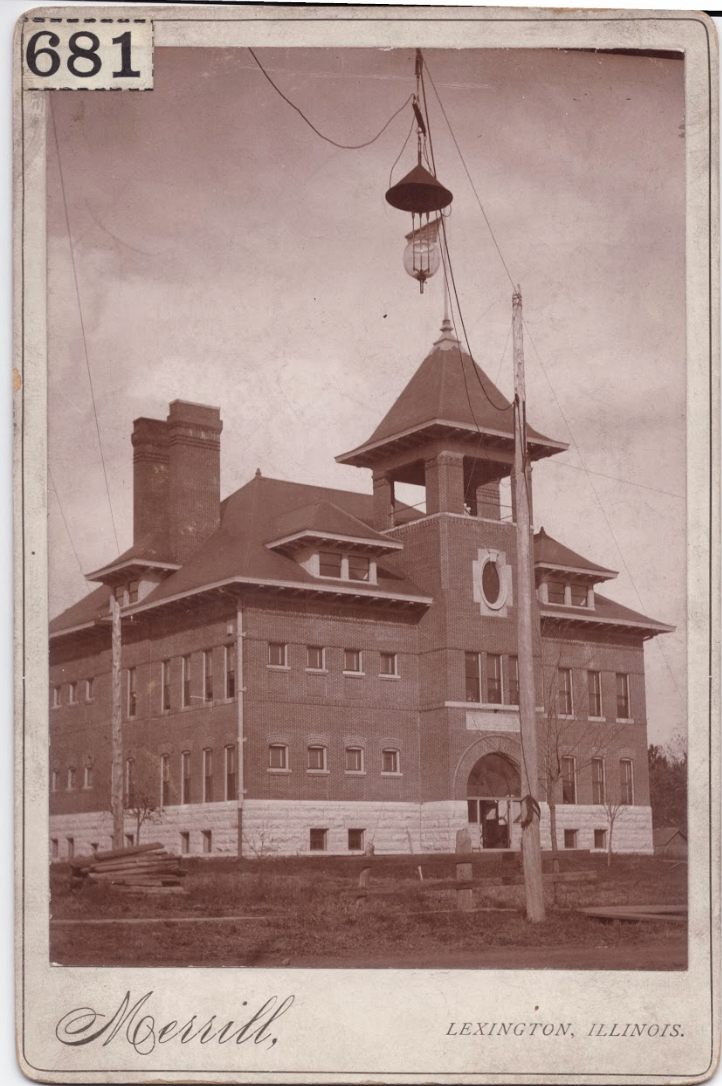
Lexington High School, Circa: Early 1900s, Source: Elizabeth MacPhail
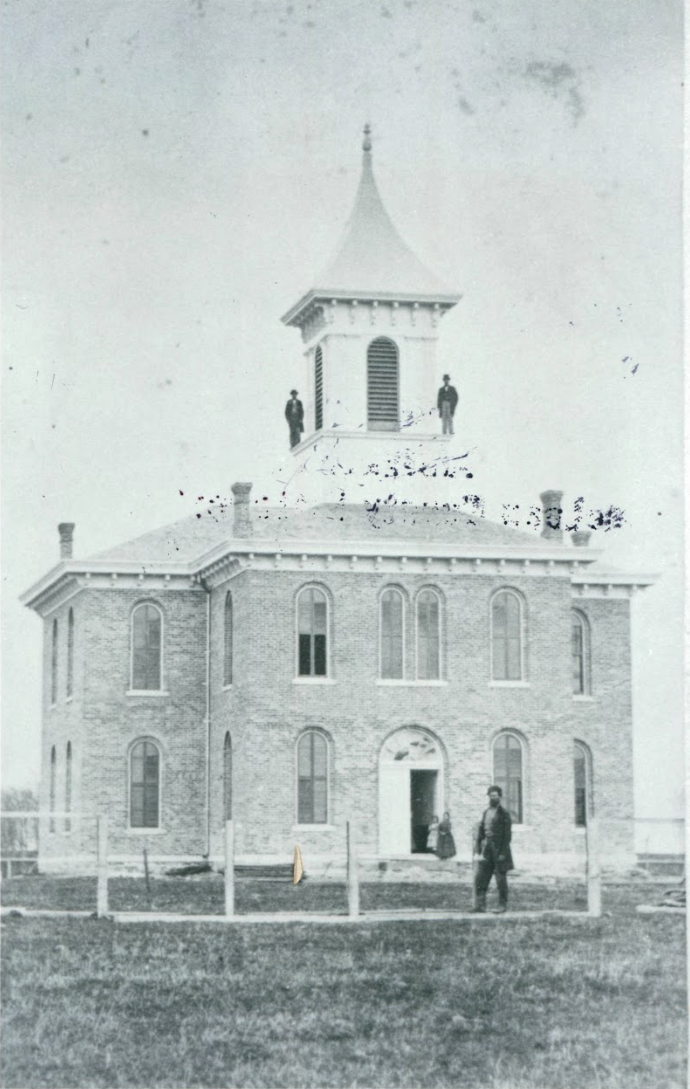
First High School in Lexington, Circa: 1965, Source: Elizabeth MacPhail

Lexington High School, Circa: 2020s, Source: Lexington Schools
Building and Rebuilding: The History of Lexington Schools
The story of education in Lexington is one of resilience and determination. From the lawless frontier to the days of public school consolidation, Lexington has insisted on prioritizing the education of its youth, even when faced with adversity; lack of resources, tornadoes, fires, and bureaucracy, to name some of the most perilous.
For the first few decades after incorporation, Lexingtonians took it upon themselves to see that their children were educated and prepared to participate in civic life. As Illinois became more established and civic programs expanded in the region, public schools became a point of pride in the community; with extensive investments and sacrifices made by the community to sustain their public schools.
Lexington is ambitious. And the ambitions of the community are shown clearly in their approach to education. As both a farming community and a stop on the Chicago & Alton railroad and later on Route 66, Lexingtonians’ main industries were (and are) agriculture and service, Lexington was on the front lines of a changing world. It is a very midwestern, practical ambition of a community that wants to thrive, sustain itself, and give its progeny the skills to successfully navigate life. The specifics of that ambition vary from family to family, but Lexington has come together to educate its children for nearly two centuries. The history of its schools is, in many ways, the history of the town itself.
Subscription Schools: A Bargain, Not a Building
The story of Lexington schools begins with a bargain, not a building. The bargain: neighbors coming together to directly pay a single teacher to educate their kids. When the first settlers pushed into McLean County in the 1820s and 1830s,. Parents who could afford formal education for their children paid a fixed sum to a teacher, who would teach a few pupils from the surrounding neighborhood. This system was known as subscription schooling. Classes were held in whatever space was available. Many of the educators were young men or women who had managed to acquire only a few more years than those they taught. The textbooks, when there were any, were non standardized and provided by the families.
As the region grew in the 19th century, McLean County was dotted with one-room schoolhouses, each serving its own cluster of farms and families. These buildings had names that reflected the new culture growing out of the land and the people settling it. There was the Bishop School, a double log cabin built in 1837 on the north bank of Money Creek. There was the Horney School, originally called Sugar Creek School in the 1840s. There was the Frog Alley School, constructed in the 1860s east of the railroad at the south side of Section 27, named for the swampy lowland it sat beside. The Popejoy School burned down in 1937 and was rebuilt the same year. The Adams School, erected by pioneer Matthew Adams near his homestead and family cemetery, burned in 1941. And there was Mt. Gilead School, named by a teacher who had come from Mt. Gilead, Ohio, carrying a piece of home into the Illinois grasslands.
The Beginning of Public Education
Illinois took its first step toward public education in 1825 with the Free School Law, which empowered counties to establish school districts and collect taxes to fund them. The legislation also set aside two percent of state treasury funds for distribution to counties in support of local schools. Pioneer citizens of Lexington Township, many of whom had just carved farms out of raw prairie, were by-and-large resistant to being taxed for the education of their neighbors' children. The law proved short-lived in its original form. An 1827 amendment made the public tax voluntary rather than mandatory, and two years later the state funding provision was eliminated entirely. It took another twenty years for the community to attempt to fund any sort of public education in earnest. A statewide school tax was eventually enacted in 1848, and by 1855 Illinois had mandated a free public school system for all.
Lexington's first public schoolhouse was built near the city square in 1850, a welcome upgrade from the original log schoolhouse on the south end of town that had served many purposes for the community.
In 1858, A.J. Anderson established Anderson's High School, running it as a subscription school. Tuition cost $3.00 for primary branches of education and $4.50 for higher English, Latin, and Greek. These were earnest operations, making up for what they lacked in square footage in grit and determination.
In 1865, a brick building with a steeple was constructed on South Street at a cost of $10,000, with Anderson at the helm as principal. By 1879, Lexington had produced its first graduating class of five students: Mary V. Gray, S.B.L. Merrill, Fannie Okeson, George B.M. Shilling, and Millie M. Stevenson.
The growing student population eventually surpassed the capacity of the brick schoolhouse. In 1896, a new two-story, eight-room school was constructed on Wall Street at a cost of $20,750. In 1912, architect George H. Miller designed a new high school right next door, built at a cost of $30,000. At the time, George Miller was one of the most prominent and prolific architects in the area; he also designed The Castle in Lexington, St. Mary’s Catholic Church in Bloomington, the McLean County Courthouse, Old Main in Charleston, and many more grand buildings in the region Tragically, just three months after the high school was dedicated, a fire destroyed the 1896 schoolhouse. The community rallied quickly, salvaging the bricks from the ruins to rebuild on the same spot. The new Lincoln Grade School was ready for occupancy before the year was over.
The mid-twentieth century brought steady growth. An athletic field was added in 1935 on the site of what is now the school's playground. In 1942, with the country at war and a generation of young men shipping out, Lexington still found the resources to add a new gymnasium and a vocational wing. The deep-rooted local values of education did not pause during hard times.
The most consequential changes in the school's history came in 1948. Until then, Lexington had maintained separate grade school and high school districts, and the surrounding countryside still operated its patchwork of one-room schools. That year, all of it was folded into the newly created Lexington Community Unit District Number 7, a single K-through-12 school that absorbed not just the village schools but around twenty rural schoolhouses from across the township. The schoolhouses were eventually auctioned off, torn down, or moved, while a handful were converted into dwellings. The era of the one-room school, a defining feature of rural Midwestern life for over a century, came to a quiet end.
The postwar decades brought further physical expansion to the Lexington campus. A modern addition in 1954 connected Lincoln Grade School on the west with the high school on the east, adding a new cafeteria and additional classroom space. A sports complex for football and baseball was developed on public property a block northeast of the main building. In 1961, a new high school was built on the south lawn in front of the older buildings: two stories of classrooms, a partial basement, a library, administrative offices, two science labs, and hallways finished in ceramic tile with terrazzo floors. The school was becoming a campus, a collection of connected structures that mapped the community's ambitions onto a few square blocks of central Lexington.
The Tornado of 1970 & The Decision of 2014
In 1970, an EF2 tornado struck the Lexington school campus with enough force to leave lasting structural damage. By 1978, Lincoln Grade School was decommissioned, and the building was condemned. In 1980, Lexington undertook a major building effort, adding a new grade school, a dedicated junior high wing, a recessed media center, a modern cafeteria, and a large gymnasium, all while salvaging the stage, existing gym, locker rooms, and band room from the damaged structures and joining everything together as one unified building. In 2001, the year Lexington’s high school football team again made it to the State Finals, vandals broke into the high school and deliberately set fires, with the heaviest damage concentrated in the administrative offices. High school students and teachers spent nearly a year in portable trailers while volunteers cleaned and repaired the building.
The next test was neither a storm nor a fire. In 2014, the district fell into hard financial times. Once again, there was talk of further consolidation with other surrounding districts; a hard loss for any community. Yet once again, Lexington came together to keep its schools afloat and in town. That year, the city voted on a new tax referendum to fund the future of Lexington education. The results seem positive, as Lexington has kept its schools in tact without risk of consolidation, and the district has grown nearly 60 percent.
Lexington Schools Today
Today, Lexington Community Unit District Number 7 serves roughly 500 students in grades PreK through 12, all on a single campus. Made possible by a decade of financial recovery and community investment, the most recent chapter began in 2025 with a large new addition to the school’s south end. Among the improvements were new classrooms for agriculture, industrial technology, art, and science. Art students, previously working in the basement, gained a ground-floor space with natural light. A new band and choir room provides long-needed additional space for the music program, which has grown rapidly in recent years. A new 600-seat gymnasium finally separates physical education from the cafeteria, which had long been forced to share in a single space.
What the history of Lexington's schools ultimately reveals is not a straight line of progress, but something more honest: a series of decisions and changes made by necessity for the improvement of the community. Lexington’s commitment to education has shown up century after century, in the community that salvaged bricks from a burning building, and in the citizens who have repeatedly chosen to fund and protect their school.
All Lexington History Project articles were written and edited by Nicholas Rynerson and Elizabeth MacPhail, with research and editorial contributions from THE FORT Historical and Genealogical Society in Lexington, Illinois.
A Note on Citations: All non-cited facts, dates, and addresses were provided from the archives of THE FORT Historical and Genealogical Society in Lexington, Illinois. For any additional information on specific town history, email THE FORT at thefortoflex@aol.com. For any suggested chronological changes regarding the information in this article please email nick@bolt-cutter.com.
Find All the Articles Around Town
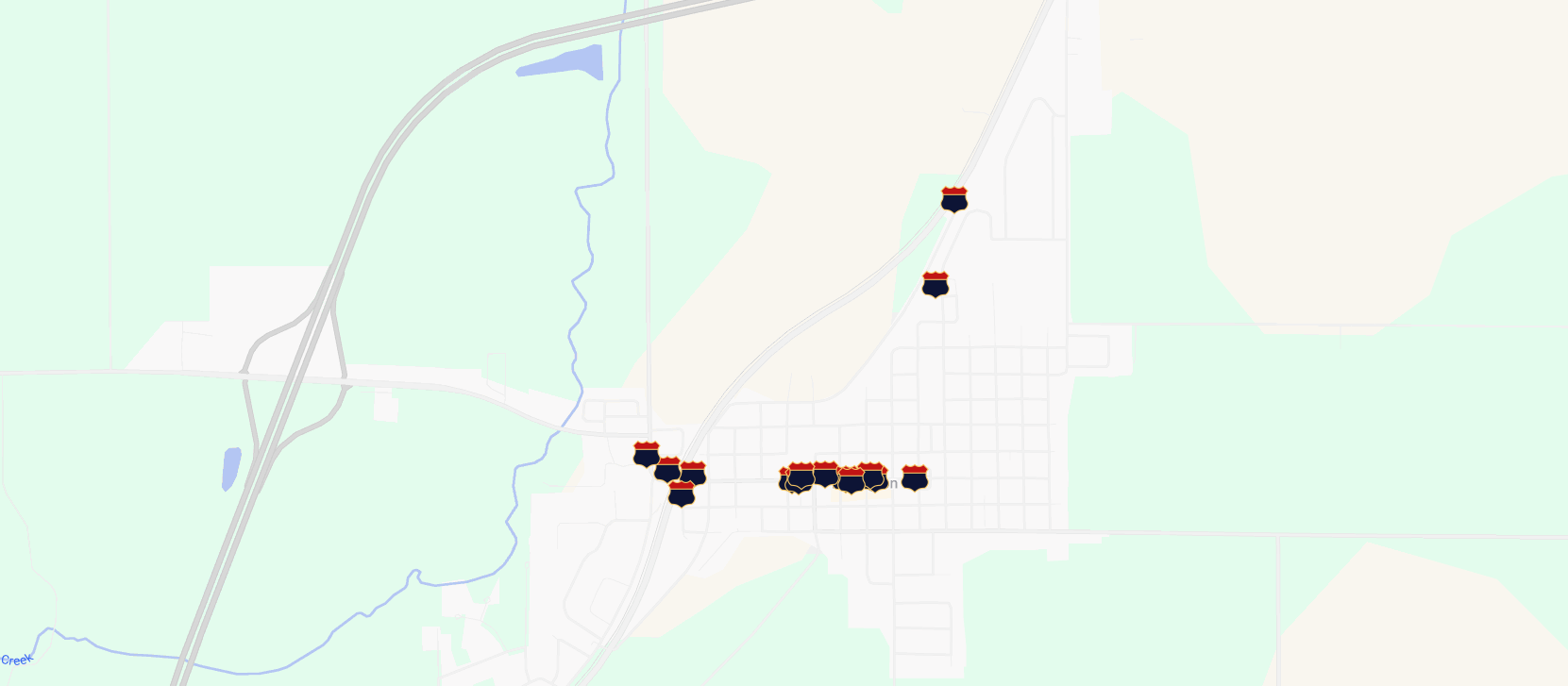
Click through the custom Google Map below to find all of the Lexington History Project signs and articles placed around town.
Presidential Visits. Supreme Court Cases. Railroads. Route 66.
Established in 1836.